
Intel Processor Execution Modes
Hello everyone I am Irfan, Today we are going to talk about Intel processor execution modes so let’s get started…..
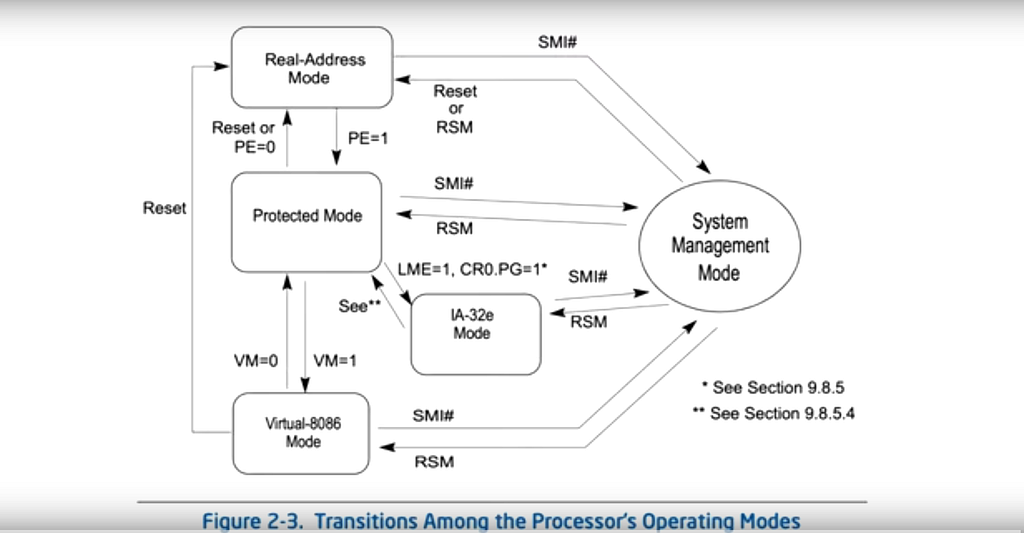
To understand intel processor execution modes intel has provided this finite state machine. So let’s start from Real-Address mode.
Real-Address mode
It is the original execution mode of the intel 8086 processor. The processor is placed in real-address mode following power-up or a reset. Old software such as DOS run in real mode. There is no virtual memory and no privilege rings in this mode. That’s why some old operating systems were not so reliable because different processes could screw all over everybody’s memory and crash the overall system. It is the job of BIOS to get you out of this mode to other modes.
Now If we started in Real mode and we got System management interrupt we will find ourselves in System management mode.
System Management mode
This mode provides an operating system or executive with a transparent mechanism for implementing platform-specific functions such as power management and system security. The processor enters SMM when the external SMM interrupt pin is activated or an SMI is received from the advanced programmable interrupt controller(APIC). SMM has the ability to protect it’s memory from all other privileged code (e;g OSes and VMMs), so it is for all the intents and purposes the most privileged execution mode on the CPU. Intel has recommended it to use for security functionality and so for long time BIOS vendors would put security critical mode into the system management mode.
Protected Mode
This mode is the native state of the processor. Among the capabilities of protected mode is the ability to direct execute ‘Real Address mode’ 8086 processor in a protected, multi-tasking environment. This feature is called virtual-8086 mode, although it is not a processor mode. Virtual-8086 is actually a processor mode attribute that can be enabled for any task. Virtual-8086 is just for backward compatibility. Protected mode adds support for virtual memory and privilege rings. Modern Operating systems operate in protected mode.
Long(IA-32e / Intel 64 / x86–64) Mode
It is the actual 64-bit mode. Intel calls it IA-32e(extended) mode.
If you want to learn more about these things, You can check this course by OpenSecurity Training Arch2001.
I hope you enjoyed it, You can follow me here on LinkedIn or Twitter.